Trip to Paris: The City Of Romance

Sunday, 12 May 2013 0 comments

A trip to Paris was always on my agenda right from my childhood days. My fascination with France and Paris in particular was primarily due to it's reputation as the most cultural and romantic of all cities in world. It is also said to be the city of lovers…the most romantic place on earth, and French is the language of love. With so much love flowing around we were destined to visit Paris some day or other. We spent days looking for the best flight and hotel deals and booked our 2 day holiday for Paris. Finally one fine afternoon we landed at the Charles de gaulle airport at Paris. Our first encounter with Paris was not so nice. The airport was looking pretty dirty and messed up. Determined not to have this first experience spoil our impression of Paris we ignored it and quickly forgot about it. We were told that if you don't know french, communication can be a challenge and by now we had realized that it was indeed true. At some of the places we felt that as if people are deliberately trying to avoid speaking English despite knowing it. Having known about the long history of enmity between France and England we assumed that probably it has to do with this historical discord between the two countries. We decided to use the Paris metro to travel to our hotel which was in central Paris. Finally after struggling for about 2 hours and getting lost at a few places we managed to reach the hotel. By this time it was late afternoon so we decided to cover the Eiffel Tower straightaway as we were keen to get a view of Paris in evening.

At the base of Eiffel Tower
When we first arrived at Eiffel tower we were pretty disappointed by looking at this ugly and dull looking iron structure standing tall in the afternoon sun. The 300m high Eiffel Tower is probably the most famous landmark in the world, and is the capital’s most visited attraction. The cast-iron tower was built for the 1889 World Fair and the centenary of the 1789 Revolution and was named after its designer, Gustave Eiffel. It took over two years to construct using some 18,000 pieces of metal and 2,500,000 rivets. It was the tallest structure in the world until New York’s Empire State Building was constructed in the 1930s. There was a long queue to get to the top of the tower and there is a series of interconnecting lifts which get you to the top. They do have stairs as well in case you want to get a little more adventurous. There were long queues all over and by the time we got to the top it was sunset time. Once you reach the top you feel the vibrations and shaking's of the tower as it's an iron structure. We could see lovely views of the city from the tower and even tried to identify a few attractions we had planned to visit next day. We could also see amazing view of the scene river just below the tower, the clear blue water and many cruises going on the river.

The Glittering Eiffel Tower


By the time we got down the tower and it was pitch dark and the Eiffel Tower was completely transformed. It was densely illuminated by bright lights from top to bottom and we were completely mesmerized to see a different Eiffel Tower glittering like gold. We were told that some 20,000 flashbulbs light up the edifice at night. There were some moving searchlights at the top which were continuously revolving and it's visible from quite a distance.


We decided to go for a cruise of the seine river next and as the darkness engulfed Paris it was truly metamorphosed into the city of romance. There were lot of floating boat hotels parked on both sides of the river and we could see people dining and dancing on those boats. The cruise boat had search lights fitted on both sides and there were historical building brightly illuminated wherever we went. All these cruise boats take a circular route from the Eiffel Tower, down past the Louvre Museum, Notre Dame Cathedral, botanical gardens then back up the other bank past Musee D'orsay. Unfortunately I don't have much photos from this trip but I've some nice videos which I'll post some time later.

We decided to spend our next entire day exploring the historical and cultural attractions of Paris atop an open top bus. Our first halt was the Louvre which is one of the finest museums in the world of art and holds treasures from the Egyptians, Etruscans, Greeks, Romans, Middle Eastern and Islamic cultures. With more than 8 million visitors each year, the Louvre is the world's most visited museum worldwide.

Our main intent at Louvre was to catch a glimpse of the famous painting of Monalisa. We barely had enough time to just locate the painting catch a quick glimpse and come out. We were a bit disappointed to see the painting as it was beyond our understanding as to why is this painting so famous. In fact there were many much more enticing and spectacular paintings spread all around the museum. In fact more than the museum artifacts we liked the entrance of the museum which is built as a glass pyramid. The pyramid and the underground lobby beneath it were created because of a series of problems with the Louvre's original main entrance, which could no longer handle the enormous number of visitors on an everyday basis. Visitors entering through the pyramid descend into the spacious lobby then re-ascend into the main Louvre buildings. The construction of the pyramid triggered considerable controversy because many people felt that the futuristic edifice looked quite out of place in front of the Louvre Museum with its classical architecture.
The glass pyramid entrance - Louvre Museum

The Inverted Pyramid
The Inverted Pyramid (visible in the picture on left) is a skylight constructed in the Carrousel du Louvre shopping mall in front of the Louvre Museum in France. The Inverted Pyramid figures prominently on the concluding pages of Dan Brown's international bestseller The Da Vinci Code. The protagonist of his novel, Robert Langdon, reads esoteric symbolism into the two pyramids: The Inverted Pyramid is perceived as a Chalice, a feminine symbol, whereas the stone pyramid below is interpreted as a Blade, a masculine symbol: the whole structure could thus express the union of the genders.

Fountains in Concorde Square
Our next halt was the Concorde square (Place de la Concorde) is one of the major public squares in Paris. There are two famous landmarks which you can see in these pictures below: The fountains and The Obelisk. The two fountains in the Place de la Concorde have been the most famous of the fountains built during the time of Louis-Philippe, and came to symbolize the fountains in Paris. Both fountains had the same form: a stone basin; six figures of tritons or naiads holding fish spouting water; six seated allegorical figures, their feet on the prows of ships, supporting the pedestal, of the circular vasque; four statues of different forms of genius in arts or crafts supporting the upper inverted upper vasque; whose water shot up and then cascaded down to the lower vasque and then the basin.

Obelisk visible on extreme left
The center of the Place is occupied by a giant Egyptian obelisk decorated with hieroglyphics exalting the reign of the pharaoh Ramesses II. It is one of two the Egyptian government gave to the French in the 19th century. The obelisk itself is a yellow granite column which rises 23 metres (75 ft) high, including the base, and weighs over 250 metric tons (280 short tons).

Notre Dame Cathedral
Our next halt was Arc de Triomphe and we could find similarities to our own India gate or gateway of India after looking at it. Under the Arc de Triomphe lies the grave of an unknown soldier. Napoleon ordered its construction in 1809 as a monument to the Republican armies. The arch is 50m high and 45m wide and bears the names of Napoleon’s victories, and is decorated with a frieze of battle scenes and sculptures.

Our next halt was the famous Notre Dame Cathedral which is a masterpiece of Gothic architecture. It was constructed between 1163 and 1334, with a huge investment of time and money which was a reflection of the city’s prosperity at the time. It was plundered during the French Revolution and since the 19th century, restoration works have been going on to restore its former glory. It was here that Henry VI was crowned, Napoleon declared himself Emperor, and it also hosted the beatification of Joan of Arc. There was some choir which was in progress inside the cathedral and we were enthralled by the mystical music flowing around. (A choir is a musical ensemble of singers.)

Sacre Coeur church
 Finally we headed towards our last halt for the day which was Sacre Coeur church. The Sacre Coeur church is perched atop the highest point in Paris and affords spectacular views of the whole city, and is a favorite among artists who spend hours painting the perfect picture of the city. The church is crowned by a distinctive 83 m dome, and a 84 m high bell-tower shelters an 18.5 ton bell with a 850 kg clapper. By this time we did not have any energy left to climb all those stairs to reach the church so we just spent some time on the stairs itself.

And our next halt was .... well it''s something you should really go and experience. Any guesses? Oh yes I'm talking about the traditional Paris cabaret. Some of the most famous cabarets worth mentioning are Lido de Paris, Le Moulin Rouge, Crazy Horse Paris etc. The Lido which remains the most popular of all has hosted a score of renowned performers over the years, from Elton John to Shirley Mac Laine. The mainstay revue, famed for its elaborate, elegant costumes and multicultural twists, features 60 dancers, 600 costumes and 23 different sets. For romantics, no visit to the city of lights would be complete without a night at the original Moulin Rouge cabaret which has inspired scores of Hollywood homages. One of the racier traditional Paris cabarets, the Crazy Horse prides itself on its distinctly burlesque aesthetic and more contemporary style. Crazy Horse is strictly for adults, whereas older teenagers might be brought along for a show at the Moulin Rouge or Lido.

Paris remains one of the attractions which has something for everybody. The city remains a favorite destination for tourists looking for a historical, cultural or romantic experience. It's an equally exciting destination for honeymooners as well as couples trying to rejuvenate their romance. Au revoir Paris and I'll be back someday for sure.

Trip to Switzerland 3 - Returning via Bern, Zurich and Alps

Thursday, 9 May 2013 0 comments

This was the 4th day of our Swiss visit and our stay at Interlaken was over. We had planned to fly back home via Zurich itself but while returning to Zurich from Interlaken we decided to take a slightly different route and made a quick stopover at Berne, the capital of Switzerland. As you can see from this trip map on the right we had made a similar stopover at the lake city of Lucerne while going to Interlaken but could not cover much other than roaming around lake Lucerne for a while. We were lucky to get around 4-5 hours to spend at Berne and we decided to make the best use of it.

A Colorful Street in Berne
Berne is a medieval city which sits on a peninsula formed by the winding course of the river Aare. The remarkable design coherence of the Berne's old town has earned it a place on the UNESCO World Heritage List. It features 4 miles of arcaded walkways along streets decked out with fountains and clock-towers. There is something very special about Berne's numerous clock towers littered along the walkways. All of them are fitted with very old astronomical clocks with sophisticated features. It is probably from those times that Swiss watches have made their mark all over world. Fountains that once provided the municipal water supply are still found every block or so in the main streets. 

Lake Zurich
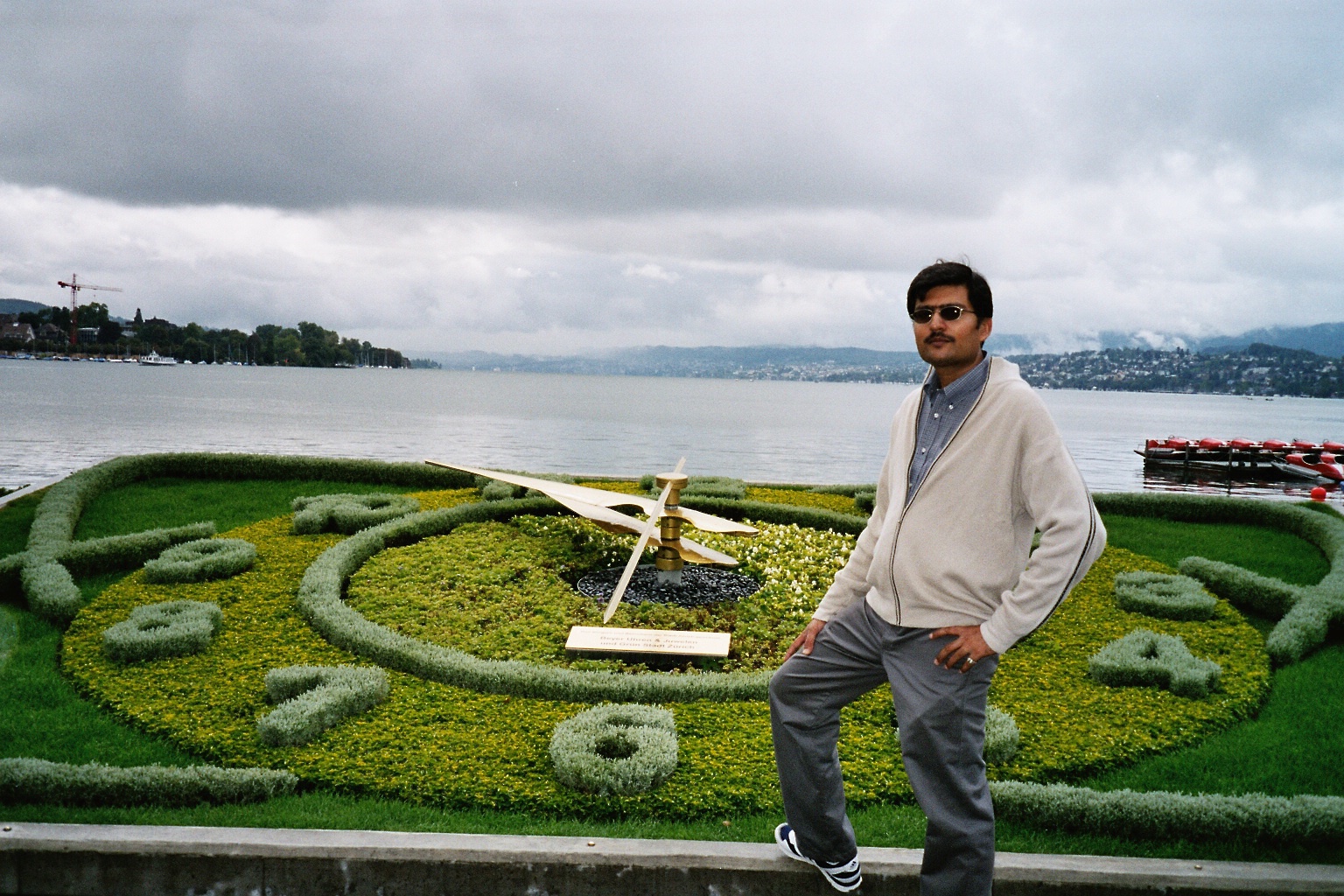
After finishing our flash trip of Berne we headed towards Zurich by a connecting train. Zurich which is the largest city of Switzerland is situated besides Lake Zurich, where the lake flows into the River Limmat , in the north of Switzerland. You can see me standing besides lake Zurich in the picture on the left. 

Zürich offers a unique mixture of attractions – over 50 museums and more than 100 art galleries, international fashion labels and the most flamboyant and lively nightlife in Switzerland. Recreational activities range from a visit to the riverside and lakeside bathing areas in the very heart of the city, to a spectacular hike on the Uetliberg mountain.

A Working clock in a real garden
We had only 3-4 hours at our disposal before catching our flight back to London so we decided to first have a cruise at Lake Zurich. By the time we had done so many cruises that the excitement of lake cruises was starting to fade out. There are some nice walkways around the lake and you can see me standing around one such area where they have created this artistic real clock ticking in the middle of a beautiful garden.

Trams in Zurich
After the lake cruise we just decided to walk around the train station and we were amazed the find the kind of fashion boutiques available on the street. Zürich’s shopping mile has contributed largely to the city's reputation as an El Dorado for shoppers and is a top address for international fashion labels, jewelry and watches. We later found out that we were actually roaming an area called Bahnhofstrasse which has the mile-long street of banks featuring exclusive fashion boutiques, department stores and street cafes invites passers-by to linger. We were a bit surprised to see many posters of our very own Bollywood actress Aishwarya Rai's posters endorsing some Swiss watch at a few places in the street. I highly recommend anybody visiting Zurich to roam around this area at least once.

Alps from the Plane Window
 Finally it was time to catch our easy-jet flight back to London Luton. We were lucky to catch some amazing views of Alps while flying over it. This is the final blog on my Swiss blog series and I leave you now with some amazing pictures of Alps taken from the window of my plane. Please keep on checking this space for my next blog series on Paris, Disneyland and Austria.


Good Bye Alps

Trip to Switzerland 2 - Excursion from Interlaken to Jungfrau Summit - Top of Europe

Saturday, 4 May 2013 0 comments

This was day 2 of our Swiss trip and it was time to start our excursion to the Jungfrau summit from Interlaken. The Jungfrau is the third-highest mountain of the Bernese Alps after the nearby Finsteraarhorn and Aletschhorn, respectively 12 and 8 km away but from Lake Thun, and the greater part of the canton of Bern, it is the most conspicuous and the nearest of the Oberland peaks. Once difficult to access, the Jungfraubahn cog railway now goes to the Jungfrau railway station at 3,454 m (11,332 ft), the highest in Europe. The construction of the Jungfraujoch railway east of the summit in the early 20th century made the area one of the most-visited places in the Alps.


Train to Jungfrau
 Once again we took our regular train from Interlaken OST to Lauterbrunnen which remains the most popular staging area for further excursions into the mountains. From Lauterbrunnen we took the cog wheel train to Kleine Scheidegg via Wengen. For those not familiar with cogwheel train, a cogwheel train is a train fitted with one or more cogwheels, which mesh with the toothed rail-rack, running usually between the normal rails. The system, operating on rack and pinion arrangement, is used in regions where trains operate on steep heights within a short span of time. There were amazing view of snow clad mountains welcoming on this most incredible train journey we were having. Although we were travelling at quite a height and it was snow all around we could open the train window and enjoy the fresh mountain air as you can see in this picture on the right. This train stopped at Kleine Scheidegg which was a pretty little train station within the mountains. We took another train from Kleine Scheidegg to Jungfraujoch and the train entered the tunnel running eastward through the Eiger shortly above Kleine Scheidegg. Before arriving at the Jungfraujoch, it stopped for a few minutes at two other stations, Eigerwand (on the north face of the Eiger) and Eismeer (on the south side), where we were allowed to get down the train to see through the holes excavated from the mountain. The tunnel station Eigerwand (2864 meters above sea level) offers a breathtaking deep view from the famous Eiger North Face, across the rocks, to the Männlichen and the entire Bernese Oberland. The second stop at the Tunnel Station, Eismeer (”Sea of Ice”), located at 3,158 meters above sea level, reveals a view of the gigantic Sea of Ice at the southeastern flank of the Eiger. The journey from Kleine Scheidegg to Jungfraujoch took approximately 50 minutes including the stops.

In the interior of the summit at Europe's highest train station, a high speed lift rose 107 m to take us to the peak with its observatory and the famous observation platform. We could see magnificent views of the mountains and the Aletsch Glacier from the observation platform. Once you reach Jungfrau, it takes a little while to get used to the thin air and may feel lightheaded initially. Also, during summer, do not forget to wear sunglasses as the glare can be quite strong. A large complex of tunnels and buildings has been constructed at the Jungfraujoch, mostly into the south side of the Mönch. There is a hotel, two restaurants, an observatory, a research station, a small cinema, a ski school, and the "Ice Palace", a collection of elaborate ice sculptures. Another tunnel leads outside to a flat, snow-covered area, where one can walk around and look down to the Konkordiaplatz and the Aletsch Glacier, as well as the surrounding mountains. It was amazing to observe such kind of infrastructure available at the top of the mountain.
Jungfrau Observatory
You can see me sitting inside the observatory in this picture on the left. If you look carefully there is a restaurant visible in the backdrop which is actually the Bollywood restaurant complete with posters of Shah Rukh Khan, Kajol and Sunny Deol. Don't believe this? Switzerland and Bollywood have a strong connection, with the latter having been featured in innumerable Hindi films like Darr and Dilwale Dulhaniya Le Jayenge.  Yash Chopra has been one of the Bollywood producers who was specially fond of this place and on 8 April 2011, he was the first person to be appointed «Ambassador of Interlaken».

The first attraction we covered after reaching the observatory was the famous ice palace. Story has it that in 1934, two local guides stared carving a glacier with their chisels and saws. Working tirelessly in the freezing cold, they slowly carved the innards of the glacier into a large hall, almost 1000 sq meters! Further then, using just their ice picks and chisels, they went on to shape beautiful sculptures out of the ice around. Slowly expanding to more chambers within the hall and adding lot many sculptures, today after 76 years, it has become a global attraction. These glacier ice masses move northwards and melt into the North Sea. To stop the Ice Palace from flowing down, it continuously needs to be sculpted, modified, and re-carved. Another obvious and major problem the Ice Palace faces is the heat. The body heat of the visitors is enough to melt the intricacies of the figures that the artists have toiled over for hours. Hence, cooling systems were installed which don’t allow the temperature to go above -3 to -2 degrees Celsius.

Ice Sculpture inside Ice Palace
You have to walk through a long and slippery tunnel cut into ice which leads you to a hall which has the ice champers and connecting passages. The chambers have stunning ice figurines of birds and animals such as eagles, penguins, and bears. Everything here is made up of ice whether it's the flooring or the walls or the arches. You can see me besides an ice sculpture in this picture on the left.

After coming back from the ice palace we decided the explore the terrace at one side of the observatory. The Aletsch glacier is directly at the foot of this observation platform. At 22km in length, the longest glacier in the Alps also belongs to the Alpine UNESCO World Heritage Site. The terrace also provides a 360-degree panoramic view overlooking the neighbouring countries of France, Germany and Italy. We tried to locate the boundaries of various countries and people pointed us towards the area where french and German borders were supposedly starting.
Jungfrau Summit

Finally it was time to experience the open mountains. At the time we went there it was pretty windy and cold and no activities were allowed in the open. There is a small area besides the observatory where you are allowed to go for a short while in bunches with other tourists. We ventured out in the open finally. It was snowing slowly but the wind speed was so high that the snow was thrashing our faces. Although we were barely able to open our eyes but it was an out of the world experience. We spent hardly 15-20 minutes outside but it was already getting unbearable and we returned to the observatory.

It was time to return to our base camp, Interlaken now. Excursion to Jungfraujoch was a once in a lifetime of experience. It's an amazing experience to come to the top of Europe with incredible ease and enjoy the Swiss natural beauty midst the impressive infrastructure created by man to make your journey comfortable.
Jungfrau Summit
Jungfrau is also a place where the harshness and beauty of nature co-exist peacefully with man-made luxury. All in all an out of the world experience. You must visit this place at least once in your lifetime.


Trip to Switzerland 1 - Excursion from Interlaken - Schilthorn and Piz Gloria

Thursday, 2 May 2013 0 comments

On day 1 of our Swiss stay we decided to cover Schilthorn which is a 2,970 meter high summit of the Bernese Alps, overlooking the valley of Lauterbrunnen in the Swiss canton of Bern. First of all we took a train from Interlaken OST to Lauterbrunnen which is a small village. These stations are connected by a narrow guage train and the train remains in the plains for most of the time during this trip which lasts around 20 minutes. We could see nice views of the Alps and lush green grasslands dotted with bunch of small yellow flowers on the way. The train runs in parallel to river Weisse Lütschine for part of the trip and it was an amazing sight seeing the river down at a depth while the train plies through the mountains.

Streets of Lauterbrunnen
After reaching Lauterbrunnen we decided to spend some time walking around and getting to the know the place. It had just rained there and was a cloudy day. You could see me walking on the streets of Lauterbrunnen on this picture on the left. We could see the mountain slopes covered with lush green grass with sheep grazing all around. There was a waterfall with a narrow stream of water falling from quite a height as you can see in the picture below.

Waterfall


At the time we visited the place we used a funicular to travel from Lauterbrunnen to Grutschap and then took a little train from there to Murren. The funicular has been now replaced by a gondola which delivers you to the same place Grutschap  from where you take the same little train to Murren. For those not familiar with funicular it's a small train with cog wheels which takes you up a very steep ride to the top of the mountain. It was an amazing ride with scenes changing every minutes. When we started at the base we could see the green grass, mid-way the journey snow flakes started to appear all around and finally we we reached the top at Grutschap it was all covered with snow.
Murren
From Grutschap we took a small train to the mountain village of Murren and this journey was even more spectacular. The train passed through the snow covered mountains and we were at quite a height.
Murren
Finally we reached the Murren village and we were told to walk through the village to a cable car which was to take up to the schilthorn mountain. Murren remains a cosy mountain village which  is the highest, continually inhabited village settlement in the canton of Bern and lies on a terrace at 1650 metres, high above the Lauterbrunnen valley. The walk through the village was quite a delight. It had snowed last night and the threes and houses were all covered with thick snow.

Murren
We could see quite a lot of houses around but it was all deserted with nobody in sight except us the tourists.

You can see some nice snaps of me enjoying the walk in Murren village.

Murren


Murren


Schilthorn Summit


Schilthorn Summit

Piz Gloria Revolving Restaurant

Piz Gloria Revolving Restaurant
Finally we reached the cable car station at Murren. From Mürren the cable car took us to Birg, which is the final change before the Schilthorn. From birg we took another cable car to the Schilthorn summit and between Birg and the summit, the cable car passes over Grauseeli, a small lake. Schilthorn has a panoramic view which spans from the Titlis, Jungfrau, Mönch, Eiger, over the Bernese Alps and the Jura mountains up to the Vosges Mountains and the Black Forest. Other than spectacular view of the mountains the main attraction is a panoramic revolving restaurant, named Piz Gloria, at the summit, which is where the James Bond movie On Her Majesty's Secret Service was set. A famous black ski run featured in the film starts at the summit and leads down to the Engetal below Birg. The restaurant revolves a full 360 degrees in 55 minutes. In the picture on the right I'm standing on the stationery part of the restaurant while the whole restaurant around me along with chairs and tables is revolving.

Jungfrau from Piz Gloria

A Graveyard at Lauterbrunnen
In another amazing picture on the right it looks as if I'm sitting besides a picture frame but it is a real view of the mountains in the backdrop. Funny isn't it! We spent some time at the summit soaking our eyes in amazing view of the snow covered peaks. In any other tourist place we had to do quite a lot of hiking and tracking to reach a place like this but we were able to reach at the mountain top enjoying our lunch at the Piz Gloria restaurant without moving our limbs too much. It can happen only in Switzerland. If there is one place which truly symbolizes the spirit of Lazy Traveller it's switzerland gentlemen. Lazy Traveller loves Switzerland and would like to come back to this again and again.

While returning to Lauterbrunen when we descended using the funicular we spotted a pretty looking garden. We decided to explore after getting down. We walked down to the garden but on arriving there we realized it's actually a graveyard. We could not believe our eyes. Even a graveyard can be so tastefully landscaped and can be beautiful.

Finally we ended our journey by taking the train back to Interlaken. We were literally taken off our feet on our first encounter with Switzerland. The truly mesmerizing natural beauty on one hand and amazing tourist friendly infrastructure on other hand. It makes Switzerland one of the top tourist destinations in worldwide. You must visit Switzerland at least once in your life. That's all for now folks and keep coming back for my remaining blogs of Jungfrau and Zurich.


Trip to Switzerland: A cherished dream come true

Tuesday, 30 April 2013 0 comments

London to Zurich
Right from the day we arrived at UK for our long stay there was one trip which was on the top of our agenda - Trip to Switzerland. For many Indians (includes me) who have grown up watching the scenes of Switzerland in movie after movie from Bollywood it remains their most cherished dreams to visit Switzerland. For those not very familiar with Switzerland's Indian connection I request them to use the web to find the endless list of Bollywood movies that were shot here. According to statistics, more than 100 Indian films have been shot in Switzerland since 1994. In fact, more Indian films than Swiss films have been shot in Switzerland. Whether it is 'Dilwale Dulhania Le Jayenge', 'Hero No 1' or 'Chori Chori Chupke Chupke', Hindi movies have a lot of footage originating in that country.

Our Trip Map
We started exploring various travel options and tourist information for Switzerland. We found some good economical ticket options using the Easy Jet flight from London Luton to Zurich. Our plan was to cover one of the most famous tourist segments of Switzerland e.g. Interlaken, Schillthorn and Jungfrau. On exploring the travel options inside Switzerland we found that it has has very well organized system of Swiss pass. The Swiss pass is a card allowing unlimited travel on the Swiss public transport network (trains, buses, ships and tramways) for a certain number of days, as well as free entry to most Swiss museums. It is available only to people not resident in Switzerland, and can be purchased at Swiss train stations or over the Internet. Although the cost of the pass was on the higher side but it remains the best way to travel and enjoy Switzerland without any hassles.


A Swiss Train
After doing lot of research one fine morning we finally took our easy jet flight from London Luton to Zurich. Just before we were about to reach Zurich we could see the glistening snow mountains of Alps shining magnificently in bright sun light. We were told that we were lucky to have the weather condition like this which allowed us to see Alps. On arriving at Zurich we took a train for Interlaken. It took us around three hours to reach Interlaken and we realized that we had taken the golden pass route which is one of the most scenic train journeys in Switzerland. The backdrop has changed drastically as the Swiss building architecture is pretty different from UK. Mid way through our journey our train descended over a enchanting lake with sparkling green water surrounded by a dense green valley. It was our first encounter with the Swiss natural beauty and we were simply exhilarated  The backdrop started changing again as the train started to climb a mountain. Swiss trains are equipped to climb even mountains and they are fitted with cog wheels which allow them to do that. By the time we reached a station on the mountain it was snowing heavily with very little visibility. Finally we reached the lovely small town of Interlaken in the evening and checked in to the Hotel.

I'll cover the details of the attractions at Interlaken in the blog and rest of the incursions from Interlaken will be covered in my next blog. Interlaken derives it's name from Lakes Thun and Lake Brienz between which it is situated. It is also surrounded by three mighty mountains, Eiger, Mönch and Jungfrau,  and is the starting point for numerous activities. There are some exciting lake cruises available at Interlaken with Excursion ships, including historic paddle steamers, plying the waters of Lake Thun and Lake Brienz.

View of Jungfrau from Interlaken
Interlaken is small enough to get around on foot or bike. Taxis are available from either train station and most hotels. With the guest card from your hotel, you can travel around Interlaken for free (it also gives discounts to local tourist attractions). The Höheweg is Interlaken's main street which runs between Interlaken West and Interlaken Ost Railway Stations. There are many souvenir shops on this street. There is a pretty grassland if you walk further down the street from where you get magnificent views of Jungfrau. There are few boutique cafes spread around the grassland and we decided to sit at one such cafe enjoying our cup of coffee and soaking our eyes in the mesmerizing natural beauty engulfing us.

Boat cruises on lakes are pretty enchanting and you must take a cruise at least on one of the lakes if not both.  The boats on Lake Thun operate from a quay adjacent to the West station, connected to Lake Thun by the Interlaken ship canal. The boats on Lake Brienz operate from a quay on the Aar river by the Ost station. We took a nice, 2 hour walk along the shores of lake of Thun (Thunersee) which goes from West train station to "Neuhaus". It takes you along the Aare river and through the small but popular nature reserve Neuhaus at the lake of Thun. From Neuhaus we took a boat back to Interlaken.

That's all for now and I'll post the memoirs of our trip to Jungfrau and Schillthorn which we took from Interlaken very soon.

A Day Trip to Windsor Castle

Sunday, 28 April 2013 0 comments

Windsor Castle has been on our travel agenda since quite some time and finally we planned a day trip to the castle during winter. For those not very familiar with the castle, Windsor Castle is an official residence of The Queen and the largest occupied castle in the world. The Queen uses the Castle both as a private home, where she usually spends the weekend, and as a Royal residence at which she undertakes certain formal duties. Many parts of the Castle are open to the public, including the precincts, the State Apartments, Queen Mary's famous dolls' house, St George's Chapel, and the Albert Memorial Chapel.
Windsor and Eton Central station

We planned our favorite transport for reaching this place e.g. the British Railways and after reaching London Paddington took a connecting First Great Western train to Windsor and Eton Central station. Although a small part is still a railway station, most of the station building has been converted into a tourist-oriented shopping center  called Windsor Royal Shopping. It is situated on the High Street, almost immediately opposite Castle Hill, the main public entrance to Windsor Castle.
Castle from Outside

Inside the Castle


A Castle Tower
You can see many views of the Castle in these pictures.
Inside the Castle
Originally designed to protect Norman dominance around the outskirts of London, and to oversee a strategically important part of the River Thames, Windsor Castle was built as a motte and bailey, with three wards surrounding a central mound. Gradually replaced with stone fortifications, the castle withstood a prolonged siege during the First Barons' War at the start of the 13th century.
A Sentry on Duty

Windsor Castle occupies a large site of more than thirteen acres (five hectares), and combines the features of a fortification, a palace, and a small town. The present-day castle was created during a sequence of phased building projects, culminating in the reconstruction work after a fire in 1992.


One of the public duties battalions or incremental companies is responsible for providing the guard at Windsor Castle. You can notice the difference in color of their dress as compared to the bright red dress worn by the guard at Buckingham Palace.


The South Wing of the Upper Ward

And this picture on the right remains my favorite picture of this trip. The magnificent South Wing of the Upper Ward standing behind the bright green grass remains one grand view of the castle not be missed.


A Cruise on Thames

While returning from the castle we decided to explore a stretch of river Thames which passes through Windsor. The picture on the left remains one of my all time favorites. A white boat sailing through the river like a swan against the backdrop of trees devoid of any leaves. This looks more like a painting. We spent around an hour here soaking our eyes in these calm and serene views.

With this it's time to say bye again. Keep coming back for an exciting coverage of European attractions in my forthcoming blogs.

 
Lazy Traveller © 2013